Low-waste kitchen
Read the Date Label Before Deciding What to Keep
A practical way to separate the wording on a package from its storage history, with clear limits on what either can tell you.
A short list of usable quantities, dinner roles and missing ingredients can help more than a beautifully arranged cupboard.
An inventory can be accurate and still be unhelpful. Knowing that there are seven tins and three bags on a shelf does not answer the question that matters at six o'clock: what can become dinner within the time available? I would rather have a slightly untidy cupboard and a useful note than a complete spreadsheet that nobody checks.
The approach here is deliberately small. Record enough to choose a meal, keep the information on the original packaging, and refresh the list at the moment it influences shopping. The examples are hypothetical household decisions, not a prescription for what anyone should eat. The point is to connect ingredients to a realistic plan without turning pantry management into another evening job.
Choose a meal you already know how to make and ask which shelf ingredients it needs. This gives the first inventory a purpose. A list headed “Tuesday pasta” is easier to complete than a project headed “organize all food.” Begin with the cupboard you will actually open for that meal. Other shelves can wait until they become relevant.
For a hypothetical two-person dinner, suppose a household has a partly used pasta packet, a sealed jar of sauce and a tin of beans. “Pasta present” is too vague. Check how much remains against the recipe or the household's usual portions, then check the preparation directions and time required. These ingredients might support a familiar meal, but their presence does not establish that there is enough for everyone or that every component belongs together.
Write the missing piece rather than adding a whole replacement meal to the shopping list. That might be more of the same pasta, a vegetable already planned for another dinner, or nothing at all. This last answer is useful: an inventory should sometimes allow a decision to end. It does not need to produce a purchase or an ambitious new recipe.
A practical line can contain four parts: ingredient, approximate amount, possible use and something that needs checking. For example, “rice, about half a packet, side for Thursday, confirm cooking time.” The note is a planning aid. The packet remains the source for instructions. There is no need to assign every item a permanent category if a plain description works better.
I use roles such as base, main ingredient and finishing ingredient as prompts rather than nutritional labels. A spoonful of paste might help flavor a meal without being enough to build one around. A bag of dried beans may be abundant but unsuitable for tonight's available preparation time. Recording that distinction is more useful than ranking every item by how full its container looks.
Choose an amount that supports the next decision. Whole unopened tins can be counted; a nearly empty bag may need checking against a recipe. Exact gram measurements make sense when the recipe requires them, but weighing every spice would make the list cumbersome. Avoid a false sense of precision: write “check before planning for four” when that is what you actually know.
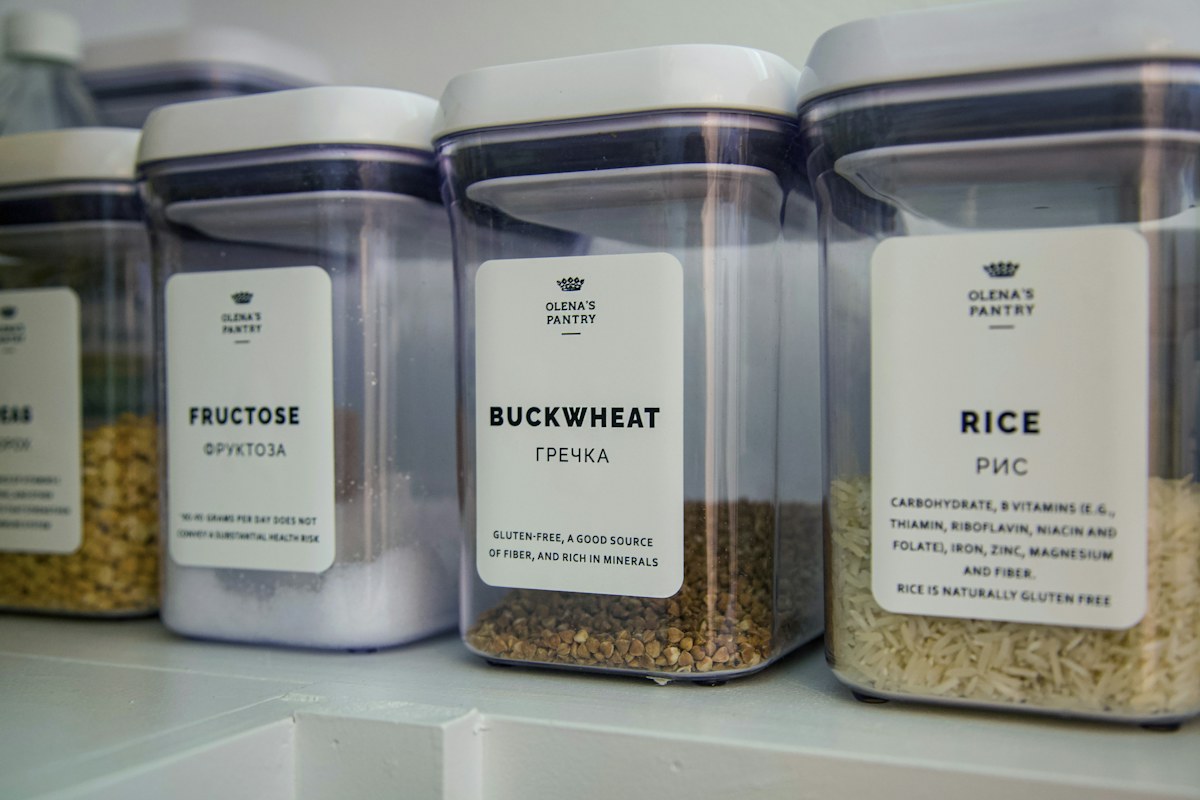
An attractive jar can remove information that will matter later. Product identity, ingredient and allergen information, preparation directions, storage instructions and relevant date or batch details are all reasons to retain the original label. Decanting is optional. If a suitable container is useful, keep the original information clearly associated with that particular food rather than relying on an abbreviated handwritten name.
Do not combine uncertain products merely to empty a packet. Two similar-looking flours or grains may have different instructions or ingredients. Keeping them identifiable makes the inventory easier to trust. If a label is missing, the notebook should record the uncertainty rather than turn a guess into an official-sounding entry. A planning system is only as useful as the information it preserves.
For a household managing food allergies, a clear list is helpful but does not control cross-contact or establish that a product is suitable. Follow the person's established food-handling needs and current product information. “Reserved for Sam” can prevent someone using a special ingredient for another meal; it is not a safety certification. Keeping those two functions distinct avoids asking a simple inventory to do work it cannot do.
Marking an opened packet can help a cook notice it before opening another one. Record an opening date when it is relevant to the manufacturer's instructions, and preserve those instructions. A mark does not extend storage life. Some products need different storage after opening; the fact that they were originally displayed on a shop shelf does not mean the pantry remains their correct destination.
Keep an uncertainty line separate from the dinner plan. That might read “unlabelled bag: do not plan around it” or “jar: check storage instructions.” This is a prompt to resolve the question, not a use-it-up challenge. A household trying to reduce waste can otherwise feel pressure to rescue every item. Avoiding an unnecessary new purchase is useful; taking a food-safety risk to improve the appearance of the list is not.
For commercial cans, USDA guidance emphasizes appropriate storage and container condition. Do not open or taste a suspect bulging or leaking can to decide whether the food is usable. Follow official handling and disposal guidance for damaged containers rather than treating this article as an inspection manual. For ordinary stock rotation, move suitable older items into view while continuing to follow their labels; visibility cannot override a safety instruction.
The US Environmental Protection Agency recommends checking existing food before shopping and buying quantities that fit a meal plan. Put the inventory review just before that decision. A list updated on Sunday but ignored until Friday may describe a cupboard that no longer exists. A quick physical check can resolve the few ingredients that would otherwise trigger duplicate purchases.
Consider a hypothetical list containing “rice, sauce, chickpeas.” Before adding all three to a basket, a shopper checks the planned meals and finds enough rice for both, one suitable sauce jar for the first, and no chickpeas for the second. The revised shopping list has one pantry item instead of three. This illustrates a decision process, not a guaranteed saving: prices, portions and what the household will actually cook still matter.
Keep a distinction between “buy now” and “replenish eventually.” Finishing a spice that is rarely used does not require an immediate replacement. Conversely, a staple needed for tomorrow may deserve attention even when a small amount remains. A photo of the short list can be enough for shopping. If the note makes people spend more time managing it than choosing dinner, reduce the number of entries.
A shared pantry needs a simple way to show what has changed. One cook can cross out a finished item; another can mark a reserved ingredient before it becomes part of an unrelated meal. Agree where the list lives and what counts as worth updating. A household does not need an entry for every teaspoon removed, but the last usable portion of an important ingredient should not silently disappear.
Location also affects whether the record is useful. Commercially canned food belongs in suitable cool, dry storage, as USDA guidance explains. Follow each product's requirements and avoid treating a damp or excessively hot storage spot as acceptable just because it has spare room. During a brief cupboard check, look for spills or damaged packaging that need attention. Cleaning makes inspection easier; it does not guarantee pest-free or safe storage.
At the next shopping review, remove meals that did not happen and revise quantities you used. Keep one line for an ingredient you want to learn to use, rather than allowing a whole shelf of aspirations to drive the menu. I would judge the system by whether it answered one real dinner question. A modest list that survives a busy week is more useful than an elaborate inventory abandoned after its first photograph.
Update the parts that affect your next decision. Cross out a finished staple when practical, then physically check the ingredients needed for the next shopping trip. There is no requirement to log every spoonful. If the list repeatedly disagrees with the cupboard, make it shorter rather than adding more tracking rules.
No. A paper note or a simple phone list can hold the ingredient, approximate quantity, intended use and anything to check. Use containers when they meet a storage need, and retain the original product information. An app is worthwhile only if the people doing the shopping and cooking will actually maintain it.
Avoid combining products when their identity or instructions would become unclear. Similar-looking ingredients may differ, and mixing them complicates tracking. Keep each food associated with its original label and relevant storage information. Convenience is not a reason to lose allergen details or rely on memory about what the container contains.
Do not build dinner around it while the question remains unresolved. Check its identity, packaging and applicable instructions, and use authoritative food-safety guidance for specific concerns. An inventory records what is present; it does not prove that an uncertain item is suitable to eat. Do not taste suspect food as a test.
Agree on one place for the shopping list and distinguish items that are reserved from those available for shared meals. Before buying, check the quantity needed for the actual plan against what remains. A quick message between cooks can help, but the physical cupboard is a better source than an inventory nobody has updated.
A useful pantry inventory ends in a manageable dinner decision. Keep quantities meaningful, preserve product information and check the cupboard when you plan to shop. Once those habits work, add detail only where it removes a recurring problem. The reward is a clearer view of the food already available and fewer decisions made from a vague memory of what might be on the shelf.
Have a correction? Contact the editors.
A practical way to separate the wording on a package from its storage history, with clear limits on what either can tell you.
Compare the route, acceptance rules and storage space before making food-scrap collection part of your kitchen.
A loading check for awkward pans, crowded racks and the dishes that keep coming back for another wash.