Low-waste kitchen
Read the Date Label Before Deciding What to Keep
A practical way to separate the wording on a package from its storage history, with clear limits on what either can tell you.
A loading check for awkward pans, crowded racks and the dishes that keep coming back for another wash.
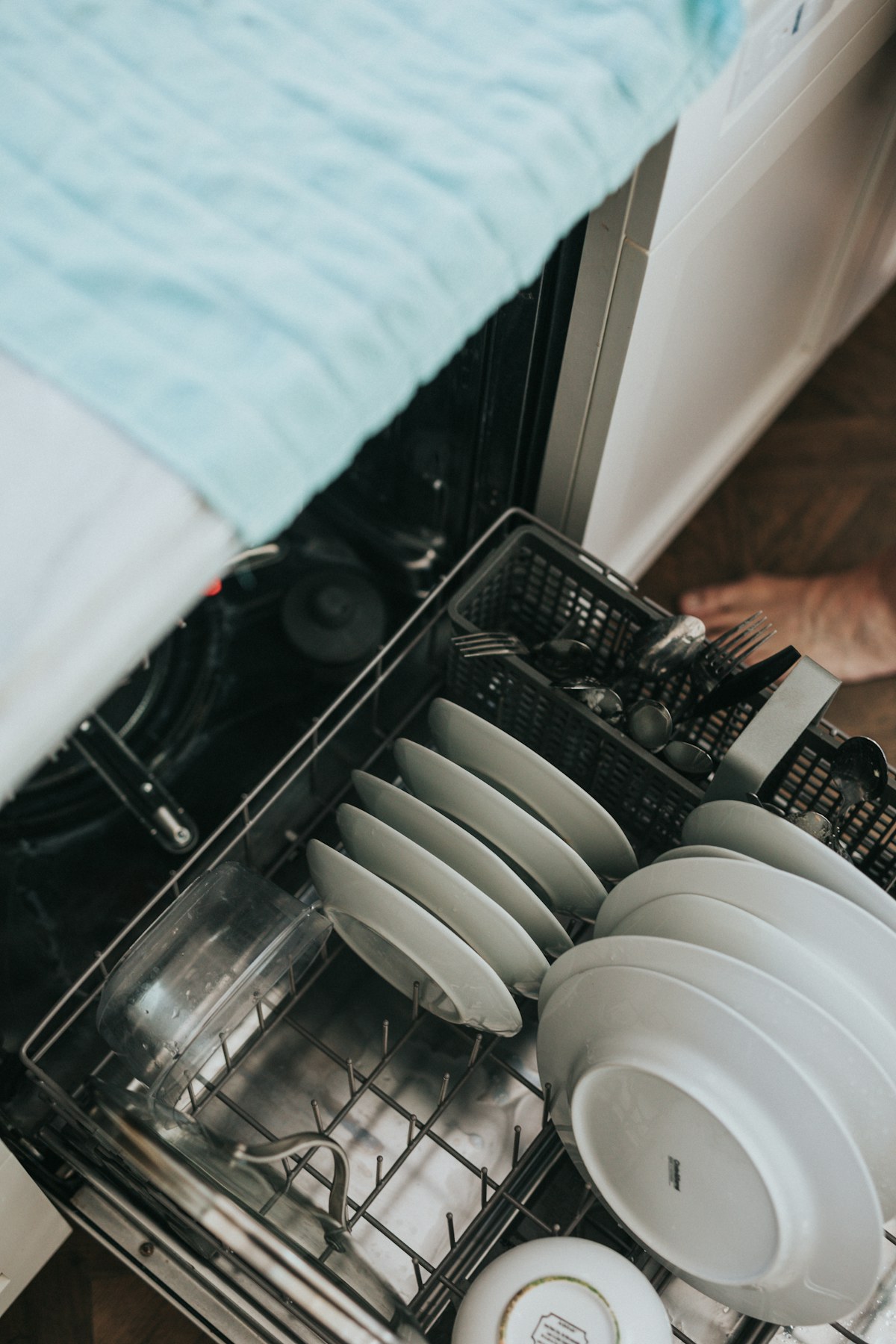
The most useful dishwasher question is not how much can fit behind the closed door. It is whether water can reach what needs cleaning. A large pan can occupy a perfectly reasonable space while shielding a row of cups above it. The machine may finish its cycle normally, leaving the household with another small washing-up job.
I would approach a troublesome load as a layout problem before assuming that the machine needs a replacement or a stronger product. This guide follows an imaginary load containing dinner plates, bowls, mugs and an awkward saucepan. The aim is a repeatable arrangement that suits the particular machine and its instructions, with room to notice what still needs attention.
The appliance manual explains the intended use of the baskets, holders and spray system. The dishware instructions answer a different question: whether the object belongs in the machine at all. Both matter. A rack can physically accommodate a wooden item, delicate decoration or unfamiliar plastic without making it suitable for the temperature, detergent and movement of a wash cycle.
Set aside anything whose suitability you cannot establish. In our imaginary load, the saucepan may be marked dishwasher safe, while an inherited decorated cup has no clear guidance. They should not receive the same treatment merely because both are dirty. An alternative cleaning method is appropriate for the cup until its care requirements are known.
Also identify any model-specific loading rules for knives, cutlery baskets and upper-rack adjustments. Do not borrow an instruction from a different model just because the baskets look similar. If the manual is missing, look it up using the appliance’s model information through the maker’s official support route. Keep the relevant loading page somewhere easy to find again.
Bosch’s loading guidance calls attention to the spray arms and to large items that can obstruct them. With the machine off and the racks in their intended positions, check the clearance according to the manual. A spoon handle projecting below a basket or a tall tray leaning into an arm’s path may be the relevant problem, regardless of the cycle selected.
The same idea applies even when an arm can turn: a broad object can shield other dishes from the water. Move the saucepan to a suitable position indicated by the manual and look at the space it leaves around nearby items. Avoid nesting bowls so tightly that their interior surfaces are hidden from the wash. Stability and access both deserve attention.
Do not force the rack, bend a holder or defeat a latch to make the object fit. If the pan does not have a suitable position, wash it separately in an appropriate way. One object being too awkward for this load is a useful conclusion. It is not a reason to overload everything else or to improvise a modification to the appliance.
ENERGY STAR recommends scraping suitable dishes rather than routinely rinsing them clean before loading. Remove large food remains in a way consistent with the machine’s guidance and your local waste rules. This does not mean loading bones, packaging or any other material the appliance is not designed to handle. The object is to prepare the load, not to make the machine a waste-disposal system.
If a dish has unusually stuck-on material, follow its care guidance and the appliance instructions rather than turning one difficult item into a new rule for every plate. A suitable soak or separate treatment may be more sensible than repeating a complete cycle because of that dish. Avoid scratching a finish or using an unsuitable chemical in an attempt to save a small amount of time.
Consider the household’s timing as well. A plate waiting until the next load is different from an object that must be used immediately. ENERGY STAR discusses using the appliance’s rinse feature where appropriate, but features and water use vary. Check what your model offers and choose deliberately. Do not assume that every appliance has the same program or that an extra cycle is always necessary.
Use a dishwasher product in the amount and location specified by the appliance and product instructions. Hand-washing liquid is not a substitute. A larger dose does not correct a spoon blocking a spray arm, just as rearranging a rack does not resolve an unsuitable product. Keep those causes separate so the next change is something you can assess.
For our hypothetical load, suppose several mugs are dirty on the same side of the upper rack. Before changing detergent, note where the pan sat below them. If all items have a similar residue across both racks, the question may be different. The pattern cannot diagnose the machine by itself, but it gives the owner’s troubleshooting guide a much clearer starting point.
Store cleaning products according to their labels, away from children and pets. Leave unfamiliar additive combinations out of the experiment. If the manual recommends rinse aid or a maintenance procedure, follow that guidance rather than a household recipe. Internal repairs, wiring and safety-switch work are outside a loading check and belong with the appropriate service professional.
A full load is useful when it can be arranged correctly and the household can wait for it. ENERGY STAR recommends running suitable full loads, but full does not mean compressed. If the final bowl blocks another surface or stops a rack moving normally, leave it for the next load or use an appropriate alternative. Capacity is constrained by shape as well as item count.
There is no need to make every load visually identical. A day with baking equipment creates a different arrangement from a day with mostly cups. Use the same decision order: suitability, stability, clearance, access and the relevant cycle. Those checks allow the layout to change while the routine remains understandable to another person who shares the kitchen.
A deadline can be part of that decision. If clean items are needed for breakfast, discuss when the machine should run and how it will be emptied safely. Do not prescribe unattended operation against the manufacturer’s instructions or household arrangements. The practical objective is clean, available dishware, not an impressive tally of how long you managed to postpone a cycle.
When the cycle is complete and the items can be handled safely, inspect the particular areas that were troublesome. Note the arrangement, program and remaining problem. A simple description such as upper mugs behind the pan is more useful than the whole load was bad. If the change helped, keep that loading choice; if not, return to the maker’s troubleshooting guidance.
Change one manageable factor at a time where possible. Rearranging the pan, replacing the detergent and switching the program together might produce a better result, but it leaves you unsure which change mattered. A brief note or an occasional photo can help another household member repeat the useful arrangement without turning washing dishes into a measurement project.
Do not turn a successful cycle into a claim about a precise water or electricity saving. That would require information about the actual programs and the alternative method. The immediate result is simpler: fewer items needing another wash and a layout that is easier to understand. Persistent poor cleaning, leaks, unusual sounds or damaged parts deserve the appropriate official troubleshooting or service route.
Not if items obstruct spray arms, shield one another or cannot sit securely. Use the capacity and loading guidance for your model. Leaving an awkward item out can be more practical than repeating a cycle because the water could not reach several dishes.
ENERGY STAR recommends scraping suitable dishes instead of routine pre-rinsing. Follow your machine’s instructions for food remains and difficult soils. A particular item needing separate treatment does not mean that every plate needs to be washed by hand before the machine runs.
No. Use the product intended for the appliance and follow its instructions. A loading article is not a reason to experiment with cleaners or improvised mixtures. If the correct product is unavailable, choose an appropriate separate washing method.
Record their location, nearby large objects, the program and the visible result. Consult the model’s troubleshooting instructions. This information can help you choose a loading adjustment or explain the problem to service support without claiming to have diagnosed an internal fault.
No. That comparison depends on your appliance, program, load and hand-washing method. This guide focuses on correct loading and avoiding unnecessary repeat work. General efficiency claims should not be presented as measurements from a particular household.
The loading routine I would keep is short: check suitability, give the spray system clearance and leave each surface a path to the water. Then inspect the result that prompted the change. A better place for one pan can be more useful than a new rule for every dish, and an item that does not fit can simply take a different route.
Have a correction? Contact the editors.
A practical way to separate the wording on a package from its storage history, with clear limits on what either can tell you.
A short list of usable quantities, dinner roles and missing ingredients can help more than a beautifully arranged cupboard.
Compare the route, acceptance rules and storage space before making food-scrap collection part of your kitchen.