Low-waste kitchen
Read the Date Label Before Deciding What to Keep
A practical way to separate the wording on a package from its storage history, with clear limits on what either can tell you.
A small map turns frozen portions into choices for dinner instead of a collection of anonymous parcels, helping you plan meals around food actually kept at home.
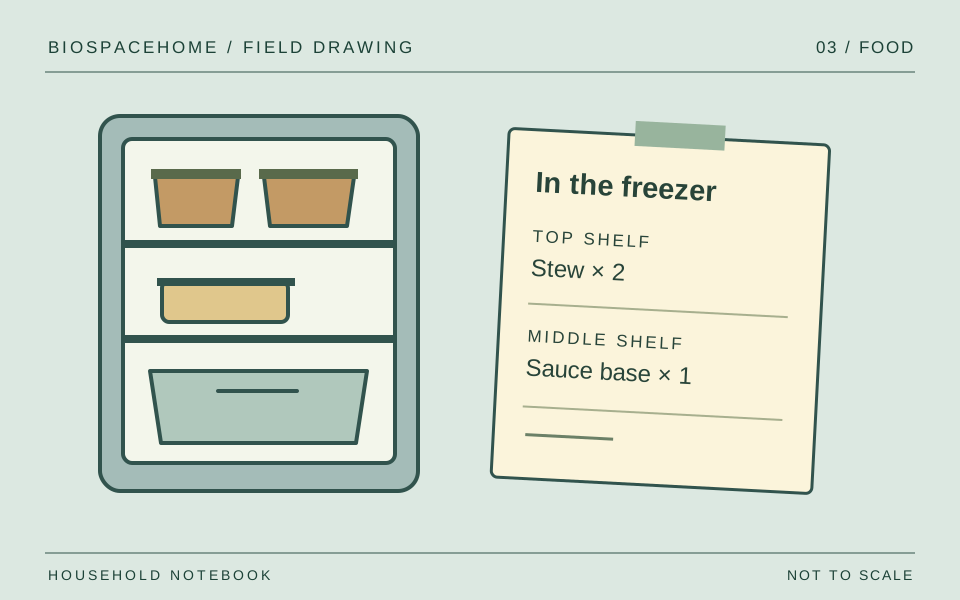
At the end of a busy day, a freezer should help answer a simple question: what can become dinner? An unmarked bag cannot answer, and a labelled package buried under other food may be hard to find. I would use a small erasable map outside the appliance to connect a meal with its location, rather than relying on a long search through every drawer.
The core idea is straightforward: record the number of portions, where they are, and what the meal needs to become complete. A labelled package remains the ultimate authority if the map ever gets out of sync, but the map itself saves you from having to pull out every sliding drawer just to find a quick dinner. By separating complete meals that still need appropriate thawing or reheating from raw ingredients and components, you can turn your frozen storage into a practical pantry.
Designing this map does not require a full afternoon of inventory or color-coded sticky notes. I would suggest starting with the very next item you put away, sketching only the physical spaces you actually use. Whether you share a small apartment kitchen with a flatmate or manage meals entirely on your own, a clear drawing keeps everyone on the same page. Let us look at how to build and maintain this system without turning kitchen planning into a chore.
Take a slip of paper and draw the freezer as you see it when the door is open: perhaps a top shelf, a wire basket, and a narrow lower drawer. A simple box with two lines across it is enough to represent the internal layout. Give each distinct space a plain name that makes immediate sense. If you live with someone else, use words that both of you naturally use in daily conversation. Blue bin is far more useful than batch-cooking zone if the blue bin is what everyone sees.
Start with the next thing you put away rather than attempting an exhaustive audit of every forgotten item. Label the actual package with its contents and the date it was frozen. Record its location on your paper index, and keep that paper outside the appliance where you can reach it instantly. The map helps you locate the package quickly, but it cannot identify an unmarked container once the map goes missing.
Imagine you have just finished cooking a large pot of lentil stew. Instead of stuffing it away blindly, you sketch a rough outline of the lower drawer on your erasable sheet. You write lentil stew alongside a tally of portions. This simple drawing requires no artistic skill, just an honest representation of where your hands actually reach when you are looking for food in a hurry.
Consider a pot of lentil stew that yields three separate lunch portions after a hearty dinner. If you know two of those lunches will not be eaten promptly within the safe refrigeration window, freeze those portions immediately while the food can still be stored safely. Pack them in suitable freezer containers, and write lentil stew, two single portions, lower drawer beside your drawing. Each time a portion comes out, strike one mark off the sheet.
A bag of sauce base is not the same promise as a complete dinner. Add a short note to your map such as needs pasta or add beans alongside the entry. That note may remind you to move dried pasta onto the shopping list while there is still time to pick it up. A family-sized box can be the right choice for a shared meal, so dividing every single dish into single portions is never a strict requirement.
In this example, keeping a tally prevents you from assuming you have four dinners when you actually have three dinners and one jar of unseasoned broth base. By counting portions rather than anonymous bags, you avoid staring at frozen lumps at six o'clock wondering how many people they might feed.
Before choosing a recipe for a hurried evening, look for one entry on your paper that does not require an unplanned trip to the shop. When the food finally leaves the freezer, update the paper immediately with your pencil. Keep that pencil tethered beside the map; the more steps an update takes, the less the count deserves your trust during a busy week.
Freezing is a planning tool for food handled safely from the start, not a rescue for leftovers with an unknown history. FoodSafety.gov lists three to four refrigerated days for soups, stews and cooked meat or poultry leftovers at 40°F (4°C) or below. If a suitable portion has no planned meal within its safe storage window, freeze it earlier while it is safe; do not wait until a deadline simply because the freezer is available.
If the map starts to disagree with the physical contents of the drawer during your search, take a moment to correct one shelf while retrieving your dinner. A small, accurate list maintained over weeks is far more useful than a perfectly drawn sheet that you no longer trust or look at.
When sharing a kitchen, a freezer map can prevent quiet frustrations over disappearing meals. Give shared dinners a distinct symbol or category on the sheet, and use initials for personal lunches stored in common bins. Ask everyone to cross out just one mark when taking a portion so the record stays relatively accurate without requiring formal kitchen meetings.
Imagine a shared freezer where one flatmate frequently prepares chili while another stocks frozen vegetable dumplings. Without a map, arguments arise over whose container occupies the prime top shelf. By assigning specific zones on the paper map, everyone can see at a glance where their provisions reside and what space remains open for new batches.
This shared visibility encourages household cooperation. If someone finishes the last portion of a shared soup, updating the board is a small task. It turns an invisible communal chore into a shared habit that respects everyone's time and food planning efforts.
Deep drawers and awkward back corners often become a black hole for kitchen inventory. Items slide out of sight, get buried under frost, and are only rediscovered months later when clearing out the appliance. The freezer map counters this physical design flaw by keeping the record out in the open on the refrigerator door.
Imagine an awkward bottom basket where round containers refuse to stack neatly, causing bags to tumble into the cracks. If an item must live in that inaccessible zone, your map entry should explicitly note its awkward location so you do not spend five freezing minutes rummaging blindly. If you notice an item has been lingering past its prime quality window, treat it honestly rather than forcing a meal around it.
Freezer storage durations recommended by food safety authorities are primarily quality guidance for food continuously kept at zero degrees Fahrenheit or below. Freezing pauses bacterial growth but does not repair unsafe prior handling before the food went into the cold. Acknowledging what is actually usable keeps your meals tasting good and prevents kitchen waste.
A map is only as good as its weekly reconciliation. Once a week, perhaps while writing your shopping list or wiping down the counters, spend two minutes comparing your paper tallies against the physical contents of the shelves. Erase ghost entries for meals that were eaten without updating the board, and add any new portions tucked away over the weekend.
When you select a meal, check its original package instructions or the linked food-storage guidance before deciding when to take it out. The map can remind you that tomorrow’s dinner needs preparation, but it should not replace safe handling instructions. Add a note such as check thawing instructions today. If your chosen dish cannot be prepared safely in the time available, pick another meal rather than improvising a shortcut.
By pairing your erasable map with sensible food safety habits, you remove guesswork from busy evenings. You open the door, look at the paper, find the labelled portion, and move forward with dinner without unnecessary stress or wasted ingredients.
Record it if it tends to disappear behind other items on crowded shelves. Leave the original package instructions with the food; the list is only an index.
Give shared dinners a symbol and use initials for personal lunches. Ask everyone to cross out just one mark when taking a portion.
Simply correct the count the next time you open that shelf. The map is a working tool, not an audited accounting ledger.
Cooked meat, poultry, soups, and stews should be refrigerated at forty degrees Fahrenheit or below and used within three to four days.
Not necessarily. Family-sized containers work well if you regularly eat together; divide portions only when you need individual lunches.
Keeping an erasable freezer map changes your kitchen routine from guessing games to clear choices. By counting portions, separating complete meals from raw ingredients, and keeping your pencil close, you can turn frozen storage into a reliable dinner planner.
Have a correction? Contact the editors.
A practical way to separate the wording on a package from its storage history, with clear limits on what either can tell you.
A short list of usable quantities, dinner roles and missing ingredients can help more than a beautifully arranged cupboard.
Compare the route, acceptance rules and storage space before making food-scrap collection part of your kitchen.